Discrete Fourier Transform (DFT)
Inverse Discrete Fourier Transform (IDFT)
R.O.C Rules
- For a causal system, the ROC extends outwards.
- For a non-causal system, the ROC extends inwards.
- For two-sided system, the ROC can extend inwards or outwards from every pole.
- The ROC cannot contain any poles.
- The system is stable if the unit circle is included in the ROC.
- For , the ROC is intersection of and , but if any pole is removed by a zero during division/partial fraction, the ROC can expand.
Z-Transform
Inf. Geometric Sum (For Z-transform)
Finite Geometric Sum
FFT Python
Compute the one-dimensional discrete Fourier Transform
np.fft.fft(a, n)
a = numpy array
n = optional, length of output
(if n > length of input, it becomes zero padding)
Compute the two-dimensional discrete Fourier Transform
np.fft.fft2(a, n)
a = 2D numpy array
n = optional, length of output
Shift the zero-frequency component to the center of the spectrum
np.fft.fftshift(a)
a = numpy array
Compute the 2-dimensional inverse discrete Fourier Transform
np.fft.ifft2(a)
a = numpy array
Return the Discrete Fourier Transform sample frequencies (Usually used for x-axis label)
np.fft.fftfreq(n)
n = integer, window length
Short-time Fourier transform
(Librosa is an audio library)
librosa.stft(a, n, h)
a = numpy array
n = integer, window length
h = stride length
Returns frequencies of a FFT
librosa.fft_frequencies(sr, n_fft)
sr = audio sampling rate
n_fft = integer, window length
Inverse short-time Fourier transform
librosa.istft(m, h, l)
m = numpy array/matrix
h = stride length
l = optional, length of output
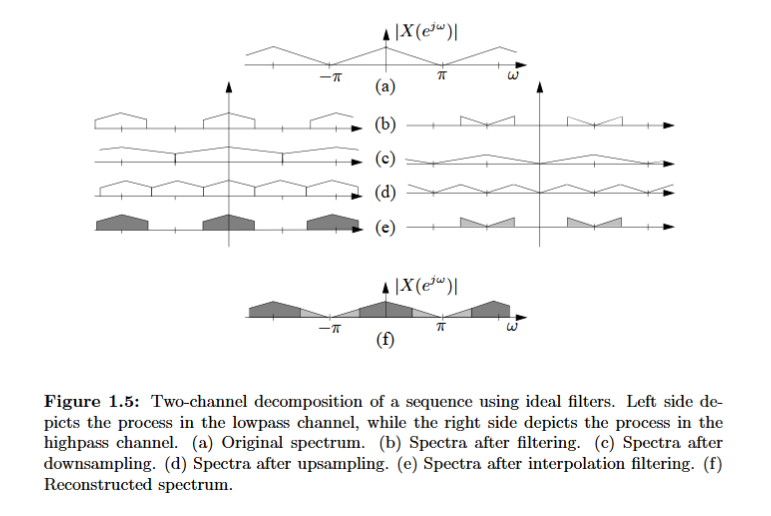
2 Channel Filter Bank